
STATUS OF OUT OF SCHOOL CHILDREN (OoSC) IN HARYANA
Status of out of school children (OoSC) was not clear before embeding of Right of Education Act in 2002. As a result of 86th constitutional amendment, Article 21A was embedded in 2002 and education became a fundamental right of every child who is above six years of age. After this historic amendment, it was realised that a big number is of out of school children (OoSC). Some of them were never admitted in the schools and some could not complete their education due to many reasons.
In April 2010, Right to Free and Compulsory Education Act came into effect with the provision of special training of out of school children. Two types of training i.e. Residential Special Training and Non-Residential Special Training; were suggested to accomplish the goal “reaching to the unreached and unaddressed groups with providing specific provision for compulsory education for every child who is above six years of age and has not yet been admitted to any school or though admitted but could not complete his or her education, then he or she shall be admitted in a class appropriate to his / her age”.
As per the 75th round of household survey by the National Sample Survey Office (NSSO) (2017-18), the number of estimated Out of School Children (OoSC) in the country in the age group of 6 to 14 years is 96.93 lakhs which might have increased considering the inequity in access to remote learning. To address this, the Department of School Education and Literacy under the Ministry of Education has released comprehensive guidelines. Guidelines are directing states to devise a fitting strategy to prevent increasing drop-outs, lower enrolments, and loss of learning.
SURVEY REPORT
A survey is conducted in the month of January to measure the status of Out of School Children in Haryana (between the age of 6-14 years) in the State. A proposal is prepared according to the number of OoSC for its submission before PAB. PAB grants proportionate funds usually in August/September and after receiving the funds, process to hire the Educational Volunteer was done immediately after survey. As 95% of OoSC are belonging to families of beggars, nomads, rag-pickers, and migrant Labour, hence most of the children identified in January move to other places usually out of the State and some new such families come at these sites/locations.
Therefore, to register present Drop-Outs and OoSC in Haryana at the specific location, a fresh survey is conducted by the EVs (in month of September /October) and these identified children are enrolled in STCs. Induction Training is imparted to the EVs before the start of STCs, regarding the bridge course and documentation of OoSC.
ACTION TAKEN BY GOVERNMENT OF HARYANA
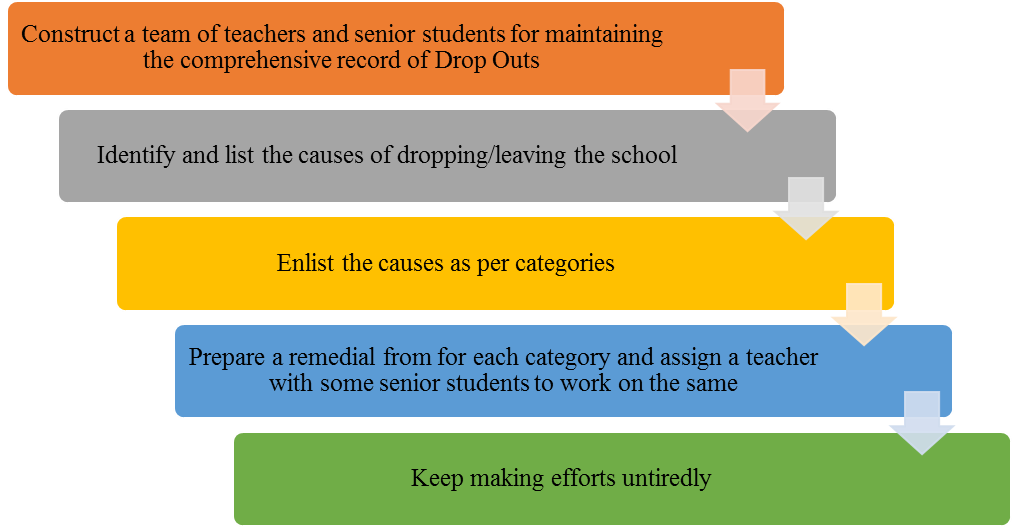
First, documents of Drop-Outs and OoSC in Haryana are prepared. Later, they are admitted in the schools to which the STCs are attached. A bridge course and study material of 6 months ST has been designed fo before their mainstreaming in their age-appropriate class. 3 month follow up has also been designed. Course ensure their retention in the school. EVs support them for their better academic understanding and adjustment with new environment and peer groups of their classes.
Talking about data in India, nearly 15 crore children are out of school where government needs to work. In Haryana a survey was conducted by Haryana School Shiksha Priyojna Parishad (HSSPP) in Aug, 2021. And identified 29097 school children from the age group of 7 to 14 years across the state. They have quit schools due to various reasons. Statistics from the report of the survey District Nuh was identified with maximum dropouts or out of school children. District Mahendergarh was having no drop-outs. In second survey was conducted in January, 2022, 17500 were identified.
Steps of dealing OoSC
Identifying and mainstreaming Drop-Outs and OoSC
- Undertaking micro planning exercises (viz., household survey in the catchment area of a given school) and child tracking;
- Providing special training (residential and non-residential);
- Redeploying unutilized government buildings and infrastructure, establishing new residential schools for reaching out to urban deprived, including street children;
- Strengthening open schooling system;
Further, the Village population and magnitude of Drop-Outs and OoSC is also having a direct impact on the feasibility of the schools to be proposed for opening or up gradation
COVERING DROP-OUTS AND OoSC AT ELEMENTARY LEVEL THROUGH SPECIAL TRAINING
The Samagra Shiksha scheme provides support for Special Training as envisaged under the RTE Act for out-of-school children. They have been admitted to regular schools to ensure that they are integrated into the school system. Such support is given in the form of residential or non-residential courses. Such children may continue even beyond 14 years of age to complete elementary education. This Special Training is based on especially designed, age-appropriate learning material as per the RTE Act, 2009. This training shall be provided by a teacher working in the school, or a specially engaged teacher.
TEACHERS’ TRAINING REGARDING OUT OF SCHOOL CHILDREN IN HARYANA
Further, These teachers will be provided additional training in order to conduct Special Training for out-of-school children.
(i) The identification exercise should be followed by immediate enrolment in school with all entitlements enabling free education and updation of the details of the child on the PRABANDH portal module
(ii) Assessment of the need of Special Training. The duration of Special Training is flexible. Training will be depending on the child’s needs, varying for a minimum period of 3 months which may be extended, based on a periodical evaluation of learning progress, for a maximum period of upto 2 years
(iii) Organisation of Special Training to enable the child to be at par with other children. Special Training may be organised in residential or non-residential mode, preferably in the premises of the school. But if such facilities are not available in school, alternate facilities which are safe, secure and accessible may be identified and used.
(iv) Actual admission of the child in the age-appropriate class on completion of Special Training. His/her participation in all class activities. At the end of the Special Training, the suitability of placing the child in a class may be assessed. For example, if a 10-year old child was admitted to Class IV. Then, received two years of Special Training till age 12. An assessment may be made as to whether the child could cope better in Class V or VI. Further, the child should be appropriately placed.

Rajni is an accomplished education professional who holds a PhD in Education and MPhil and MA degrees in Economics. She has extensive experience in research, having published over 16 research articles in peer-reviewed journals and contributed to articles in an edited book. Additionally, Rajni has authored a book in the field of education.
Rajni is passionate about making a difference in the field of education. She is an aspirant who is eager to do something innovative and valuable and is constantly striving towards creating a positive impact. She believes that education is a powerful tool which can change lives and that every student deserves access to quality education.
Rajni has a strong work ethic and a deep commitment to her profession. She is driven by her passion to learn, explore and contribute to the growth of the education sector. Her knowledge and experience in Economics and Education, combined with her intellectual curiosity and research skills, place her in a unique position to push the boundaries and creatively tackle complex challenges in the education field.
Overall, Rajni is an accomplished and driven professional who is poised to continue making a meaningful contribution in the field of education.
Your point of view caught my eye and was very interesting. Thanks. I have a question for you.