
Career Planning: Understanding Yourself Before Choosing a Career
“What do you want to become in the future?”
This is one of the most common questions students hear. While some answer confidently, many feel confused because they are still discovering themselves and the world around them. If you don’t have a clear answer yet, don’t worry. You are not alone. Choosing a career is one of the important decisions in life, but it is not something that should be rushed. Career planning is a journey of understanding yourself, exploring opportunities, learning new skills, and making informed decisions over time. The purpose of career planning is not to find the “perfect career” at a young age. Instead, it is to prepare yourself for a meaningful future by making thoughtful choices at every stage of life.
What Is Career Planning?
Career planning is the process of understanding yourself, exploring different career opportunities, setting goals, and preparing for the future through education, skill development, and informed decision-making. It is not about deciding your entire future today. Instead, it is about taking one step at a time and moving in the right direction. Good career planning helps you:
- Make better academic decisions.
- Discover suitable career options.
- Develop future-ready skills.
- Build confidence in decision-making.
- Prepare for a changing world of work.
Career planning is not a one-time activity. As you grow, learn, and gain new experiences, your career goals may also change. Therefore, career planning is a continuous process.
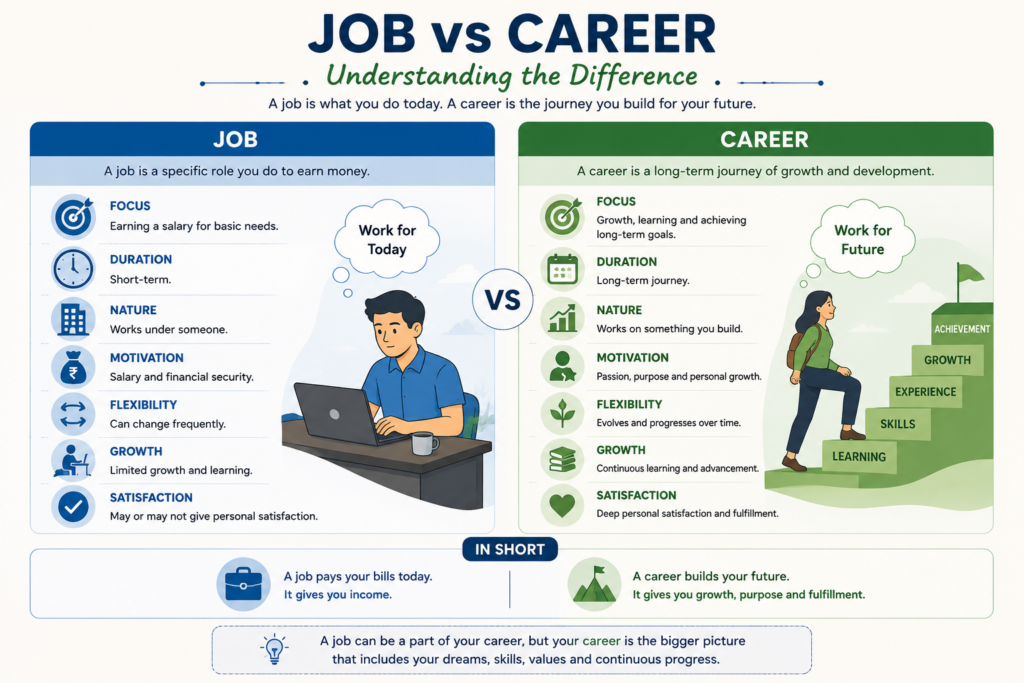
Career vs Job
Many people think a job and a career mean the same thing. However, there is an important difference. A job is work that you do to earn an income. It is usually a specific role performed for a particular period. A career is your long-term professional journey. It includes your education, training, skills, work experiences, achievements, and continuous learning. For example, a person may begin as a trainee teacher, later become a teacher, then a principal, and eventually an education consultant. These different roles together form a career.
A job helps you earn a living, while a career helps you build a meaningful professional life.
Why Is Career Planning Important?
The world of work is changing rapidly. New careers are emerging, technology is transforming existing professions, and many future jobs do not even exist today. Therefore, career planning has become more important than ever. However, career planning does not mean deciding your profession at an early age. It means developing career awareness, exploring different opportunities, and preparing yourself to make informed decisions whenever required. Remember, choosing a career is not a race. It is a journey.
Understanding Yourself: The First Step
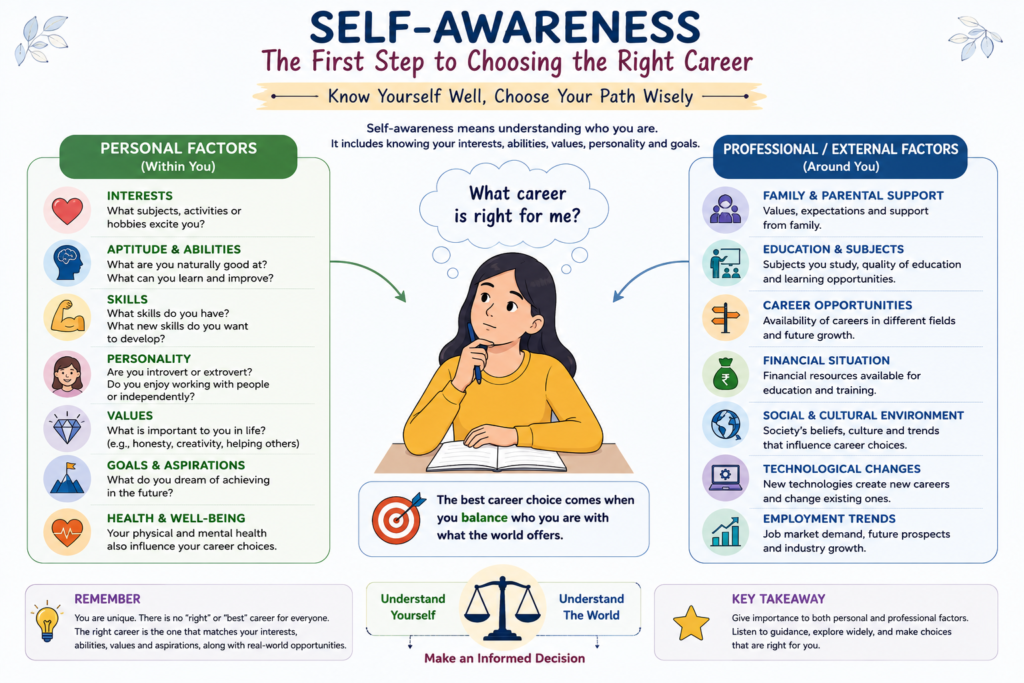
Before choosing a career, it is important to understand yourself. This is known as self-awareness. Self-awareness means understanding your:
- Interests
- Abilities
- Aptitude
- Personality
- Values
- Skills
- Strengths
- Areas for improvement
- Goals and aspirations
The better you know yourself, the easier it becomes to identify careers that match who you are. However, there is something equally important to remember. Many students think they should already know their interests. In reality, self-awareness develops gradually. As we grow, our interests, abilities, and goals also change. Sometimes we discover our strengths only after trying something new. A student may discover an interest in public speaking after participating in a debate. Another may realise a passion for coding after attending a workshop. Someone else may develop an interest in psychology after volunteering in the community.Therefore, do not worry if you have not discovered your passion yet. Keep exploring.
Internal and External Factors Influence Career Choice
Career decisions are influenced by both internal and external factors.
Internal Factors
These are the qualities that come from within you. They include:
- Interests
- Aptitude
- Personality
- Skills
- Values
- Health
- Strengths
These factors help you understand what kind of work may suit you.
External Factors
Career choices are also influenced by the environment around us. These include:
- Parents and family
- Teachers and mentors
- Friends and peers
- School opportunities
- Financial situation
- Availability of courses
- Career opportunities
- Technology and employment trends
Many students believe they should either follow only their own interests or simply do whatever others suggest. Neither approach is ideal. Parents, teachers, and mentors often have valuable experience. They understand practical realities that young students may not yet see. Their guidance should be respected. At the same time, your interests, abilities, and aspirations also matter. The best career decisions are made by balancing your own understanding with the guidance of experienced people.
Why Career Exploration Matters
One of the biggest reasons students feel confused about careers is that they have not been exposed to enough opportunities. You cannot develop an interest in something you have never experienced. A student who has never played a musical instrument may never discover a talent for music. Someone who has never participated in a science exhibition may never realise how much they enjoy research. Similarly, trying sports, art, coding, writing, theatre, volunteering, or entrepreneurship can open completely new possibilities. Therefore, career planning is not only about knowing yourself—it is also about exploring the world around you. Every new experience teaches you something about yourself.
Common Career Myths
Many career decisions are influenced by myths rather than facts.
Myth: Only doctors and engineers are successful.
Reality: Today, there are hundreds of rewarding careers across different fields.
Myth: Good marks alone decide your future.
Reality: Academic performance is important, but skills, attitude, communication, creativity, adaptability, and continuous learning are equally valuable.
Myth: I should choose the same career as my friends.
Reality: Every individual is unique. Your career should match your own interests, abilities, values, and aspirations.
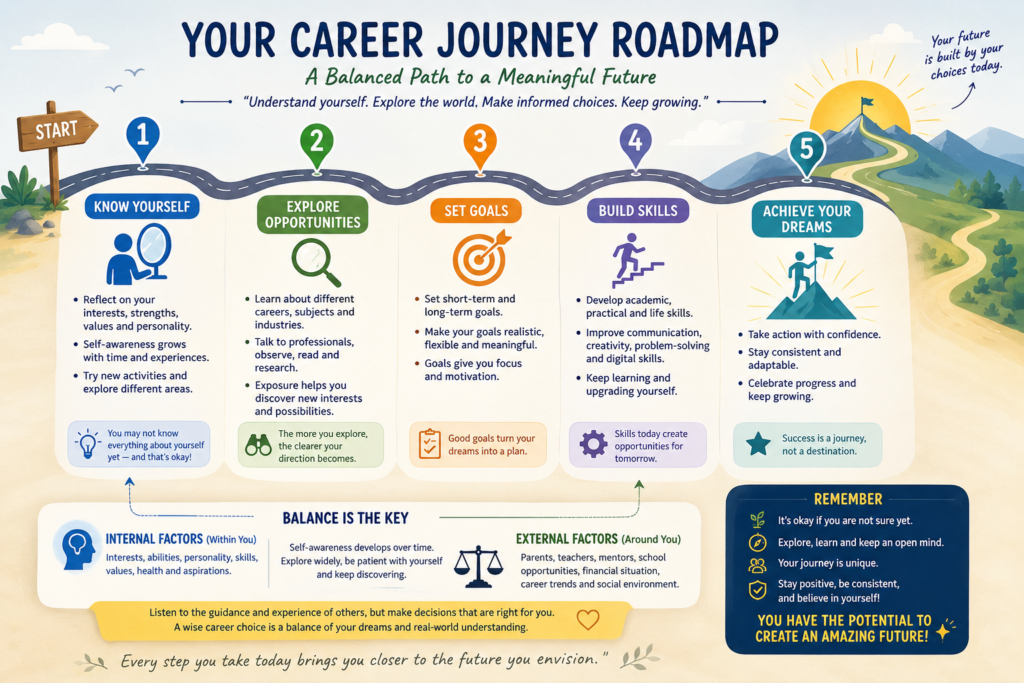
A Simple Career Planning Roadmap
Career planning does not happen in one day. It develops step by step.
Know Yourself → Explore Opportunities → Set Goals → Build Skills → Achieve Your Dreams
Every step prepares you for the next one.
Final Thoughts
There is no single “perfect career” waiting for you. The right career is built gradually through learning, exploring, reflecting, and making informed decisions. Listen to your parents, teachers, and mentors because their experience can guide you. At the same time, continue understanding yourself through new experiences and honest self-reflection. Career planning is not about choosing between your dreams and practical advice. It is about balancing both. Remember, the goal is not to choose a career quickly. The goal is to choose it wisely. Stay curious. Keep exploring. Believe in your potential. Your career is not decided by one examination or one decision—it is shaped by the choices you make and the experiences you gain throughout your life.

Rajni is an accomplished education professional who holds a PhD in Education and MPhil and MA degrees in Economics. She has extensive experience in research, having published over 16 research articles in peer-reviewed journals and contributed to articles in an edited book. Additionally, Rajni has authored a book in the field of education.
Rajni is passionate about making a difference in the field of education. She is an aspirant who is eager to do something innovative and valuable and is constantly striving towards creating a positive impact. She believes that education is a powerful tool which can change lives and that every student deserves access to quality education.
Rajni has a strong work ethic and a deep commitment to her profession. She is driven by her passion to learn, explore and contribute to the growth of the education sector. Her knowledge and experience in Economics and Education, combined with her intellectual curiosity and research skills, place her in a unique position to push the boundaries and creatively tackle complex challenges in the education field.
Overall, Rajni is an accomplished and driven professional who is poised to continue making a meaningful contribution in the field of education.